| Marvin Swartz Saskatchewan Painter The red river cart, enduring and versatile as it was, presented the Saskatchewan cart driver with one unyielding problem: the Saskatchewan River.
Capable as this craft was of fording deep mud holes and riding nicely on untrustworthy prairie sod, the wheels, known for the remarkable shriek they produced, became silent at the river's edge.
Casting off the oxen that plodded this solid vehicle from Canadian trading posts to St. Paul, Minnesota, the driver lashed the wheels to the underside, wrapped the cart tightly in buffalo hide and cast himself into the Saskatchewan River current and the dangers and inconvenience of another river crossing.
By the middle 1800s, settlement was far eclipsing the fur trade as the primary occupation in the North West. The Saskatchewan and other rivers, which to fur traders had been a superhighway, were becoming significant obstacles to travel.
The obstacle generated an enormous and ingenious industry of ferry service across the Saskatchewan that lasted from the 1860s to World War II. Today, the ferries that played such a central and defining role for the river region have faded to a much less prominent position in the province's roadways that is, for the moment, secure in its quaint reminder of a different kind of prairie.
Marvin Swartz Saskatchewan Painter "I'm hoping that not only will my paintings illustrate the ferry's unique role in the province, but that the data I collect will also help demonstrate the significance that this transportation has had in the growth and development of Saskatchewan," says painter Marvin Swartz.
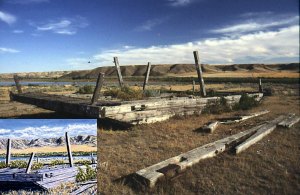
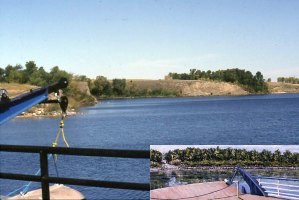
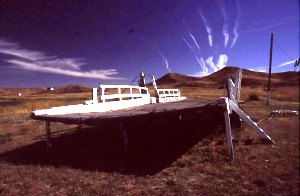
Swartz has undertaken a memorial of the ferries, a series of oil paintings called the Lifelines Project. Ultimately the project will contain about 100 paintings.
The inception of ferry crossings in Saskatchewan was humble. In 1871, Xavier Letendre established a ferry service on the South Saskatchewan at Batoche. A little further south and roughly at the same time, Gabriel Dumont serviced church-goers at a site that now bears his name. By 1926, the number of ferries peaked at 47 and economic and social activity depended upon the lift across the water as a literal lifeline.
Not surprisingly, bridges made the ferry a redundancy and a massive bridge-building campaign in the 1930s and 1940s took many of the boats off the water.
The 12 ferries that can still be found linking rural areas to main traffic arteries continue to carry respectable payloads on an average day. "Some of the ferries have about 70 vehicles a day and some as many as 120 a day," says Darryl Starling who acts as area manager for ferries in the Saskatoon district. The ferries have been a provincial responsibility since 1905 and are currently managed by the Ministry of Highways and Transportation.
The active fleet today is found on less travelled roads and, according to Starling, that grants them some security for the future.
"The future is pretty hard to predict," he says, "but we expect them to be around for a while. There aren't any bridge-building plans right now."
The economic role that the ferries play in rural communities has diminished but Swartz is confident that they did play an integral role in how the Saskatchewan River region was shaped.
"It's not unlike when the rail line came through Duck Lake instead of Batoche," he says. "Batoche basically died. Communities would petition authorities to have a ferry connect their town because economic prosperity and the ferries went together."
Keeping the ferries operating from spring break-up through to the winter freeze was a task that was carried out with monumental dedication and has delivered legends into the provincial record.
Marvin Swartz Saskatchewan Painter Norman Kilgour was the head ferryman at the Nipawin crossing of the Saskatchewan during the 1920s and 1930s. The accounts of his bearing suggest that he regarded the regular passage of people across his post as an obligation of honour.
"Mr. Kilgour filled two positions, that of head ferryman and cook," wrote George Evans in the Nipawin Journal, 1952. Evans worked with Kilgour on the ferry in the spring of 1927. "He was nearing 70 years of age," said Evans, "and was as hard and tireless as a man made of steel. He had worked for the department long enough to be entitled to a pension, but kept refusing the pension, preferring to work for his living."
The ferries came to Saskatchewan during rapid growth and frontier enthusiasm which is always fertile ground for legend. But the dangers of river crossings in spring runoff were real and the sacrifice of personal safety to get people across the water was not uncommon.
In the spring of 1928, Kilgour, Evans and another assistant risked a rapidly rising river to get one last load of horses and a Model T across. A massive spruce tree, carried whole in the quarter-mile wide current, smashed their ferry.
"With her front end foundering and her stern rising," wrote Evans, "the deck of the ferry soon had a sharp incline. The forward slope of the deck was now proving too much for the horses and they were sliding down against the big chain across the end of the ferry. With the weight all thus piled on the front end, the ferry took one tremendous shudder. I saw the stern lift so high the rowboat tied there stood straight up on end. With one mighty bound the ferry boat came up out of the water like a cork released from an air gun.
"We now took stock of our predicament and found we were headed straight down the broad Saskatchewan River, destination unknown, and with no means of controlling our craft."
Every era has legendary people who confront an obstacle with unusual commitment that catapult a society into the next era. The red river cart driver waited at the water's edge for dozens of men like Kilgour to accelerate the machinery of a burgeoning economy. The ferries provided a relatively short but essential link between the pre- and post-industrial periods in Saskatchewan's history.
For Swartz, the paintings that have come out of that link are both poetic and a matter of record.
"Each site possessed its own captivating charm, with its own unique view of the river and the surrounding landscape. I also felt a strong sense of the history of the places and realized how ferries have played, and continue to play a unique role in the province's life."
Reproduced with permission from Saskatchewan Naturally Magazine Vol. 1 No. 2 pg. 36-41. |